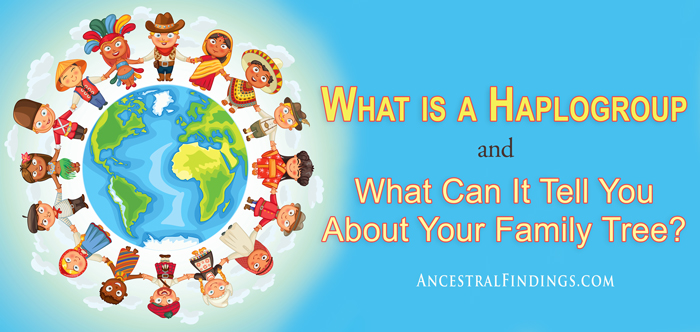
What is a Haplogroup and What Can It Tell You About Your Family Tree?

What-is-a-Haplogroup-and-What-Can-It-Tell-You-About-Your-Family-Tree

If you get your DNA tested, chances are you will come across the term “haplogroup.” What is a haplogroup and how does it pertain to your family history? At its essence, a haplogroup is an ancestral clan. Some clans are the Vikings, Native Americans (all tribes), Celts, Aborignal Australians, and other such groups. Your haplogroup tells you where your ancestors came from deep back in time.

There are also male and female haplogroups, so you can see where your male and female sides of the family originated back in pre-historic times. As with Y-DNA (which traces the male line from father to son) and mtDNA (which traces the female line from mother to daughter), haplogroups also follow straight male and female descendancy lines.

Learn More

Y-DNA and the Enigma of Richard III

y-dna-and-the-enigma-of-richard-iii

It is now well known in the genealogical world that the long-missing remains of Richard III, king of England from 1483-1485, were discovered underneath a parking lot in the United Kingdom a few years ago. While the appearance and condition of the skeleton would have provided enough anecdotal evidence consistent with contemporary accounts of his appearance and the battle that killed him to identify it as Richard, it was the mtDNA that gave researchers a definitive identification of this infamous king.

The mtDNA used to identify Richard comes from the mother’s side of the family, and is passed down to daughters and sons. However, only daughters can pass it on to their children; sons cannot. Researchers who unearthed the skeleton and did the tests necessary to identify it included genealogy in their methods; to identify Richard based on his mtDNA, they needed a direct-line female descendant of his mother, Cecily Neville. Cecily had many children… thirteen or even fourteen by some accounts. Only two of them outlived her.

Learn More

How to Find Adoption Records if You Need Them

How to Find Adoption Records if You Need Them

There are several different reasons you might want or need to look up adoption records for your genealogical research. One reason is to find information about your own birth parents, if you were adopted and were not told anything about them. Another reason is to look up information on the biological families of your adopted ancestors, so you can keep both a biological and adopted family history. You may also want to look up adoption records so you can research people in either of these scenarios in order to create a health history for yourself and your children. If you need to look for adoption records, here’s some methods you can use to find them.

Learn More