


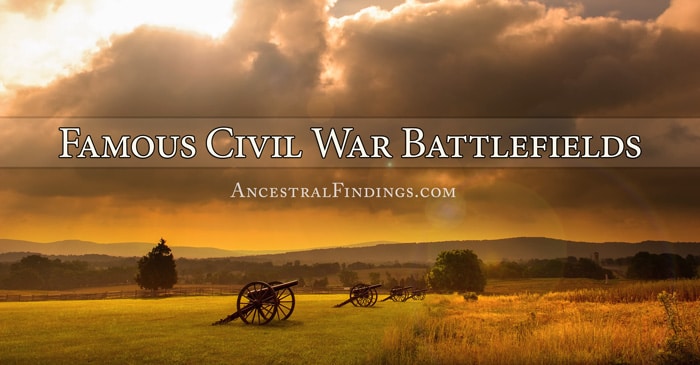
If you believe the purpose of a vacation is to truly make you feel an emotion you can’t really achieve during your normal day, you might want to consider traveling to one of America’s famed Civil War battle fields as a destination. There’s nothing as chill-inducing as visiting the exact spot where the history of the country changed; traveling to these astonishing battlegrounds enables you to get a first-hand glimpse into the horrors and heroism of war that shaped the destiny of the country. So, if you’re planning on trekking to one of the famous Civil War battlefields across the country, which ones should be on the top of your list? Here are few sites that my family have visited over the past few years.
GETTYSBURG, PA
This is the site of the most famous battle ever fought on American soil, and the turning point for the entire Civil War. Fought over three tumultuous days (July 1-3, 1863), the decisive defeat of the Confederate armies at the small but crucial junction town in Pennsylvania is one of the most iconic milestones in American and world history. A Union loss would have given the Confederate armies an important morale boost, crucial supplies and a platform to invade crucial spots in the Northeast; however, a stout defense by the North threw back the Southern advance and struck a blow from which the Confederacy would never recover. The battle is well-remembered for the heroic defense of Little Round Top by Maine Col. Joshua Lawrence Chamberlain and the famous but fatal “Pickett’s Charge,” lead by Southern Gen. George Pickett. At present day, the beautiful Gettysburg National Park and Gettysburg National Cemetery remain one of the nation’s most visited and most goosebump-inducing sites.
SHILOH, TN
This two-day battle in 1862 was the first major victory in the career of Union General Ulysses S. Grant, and it proved his worth as a general to Abraham Lincoln. An important, hard-won victory in the Union’s southern advance through Tennessee, Grant’s actions helped stem a crucial Confederate northern swing and also cost the Confederacy one of its most important generals – Maj. Gen. Albert S. Johnston, who was killed on the first day of the battle. Today, the Shiloh National Military Park offers a visitor center and cemetery to visit and also features several “living history” opportunities throughout the year.
ANTIETAM, MD
Over 20,000 men were killed in one day at the bloody Battle of Antietam in 1862, as Confederate General Robert E. Lee and Northern General George McClellan faced off for control of the state of Maryland. The long and extraordinarily deadly battle resulted in a draw but prompted President Abraham Lincoln to issue his historic “Emancipation Proclamation” in the aftermath of the battle. Currently, the Antietam grounds are preserved at the Antietam National Battlefield, with a cemetery and a museum for visitors to tour.
MANASSAS, VA
This site hosted not one but two vital battles in the Civil War, as the armies of both sides battled for its crucial rail junction. The first – the First Battle of Manassas (or the First Battle of Bull Run) – was the first major warfare of the conflict in July 1861, a victory for the Confederacy. The battle also made a hero of the immortal Southern general Thomas “Stonewall” Jackson. The Second Battle of Manassas (or the Second Battle of Bull Run) took place a little over a year later and was another victory in the glorious but brief wartime career of “Stonewall” Jackson. Visitors to Manassas today can explore the Manassas National Battlefield Park, a beautiful and well-preserved ground that contains tributes to both battles.
VICKSBURG, MS
This crucial battle combined with the defeat at Gettysburg to deal the Confederacy a fatal blow. Under the leadership of Gen. Ulysses S. Grant, the Northern Army of Tennessee executed a devastating siege on this crucial town on the Mississippi River, opening up the crucial waterway to the armies of the North and cutting a wide swath through the south. Today, the Vicksburg National Military Park offers a spectacular array of monuments and markers, as well as the wreck of the U.S.S. Cairo.
These are just a few of the more prominent Civil War battlefields – there are dozens of others across the country that we’re planning to visit, each with their own unique and unforgettable historical treasures to present to a visitor. It’s a perfect educational trip for the entire family – you’re sure to have an experience that you’ll never forget.
Looking for more information on Civil War battlefield destinations? Click here.
- Civil War Confederate Pension Applications Index (Free Lookup)
- Massachusetts Civil War Soldiers and Sailors, 1861-1865 Military Records (Free Lookup)
- Roll of Honor: Civil War Union Soldiers Military Records (Free Lookup)


 That same year, the island was given to the government of the State of California. The state decided to turn the entire island into a State Park with a Coast Guard station, which is how it is used today. Visitors and residents of San Francisco can reach Angel Island via ferry from San Francisco, Tiburon, and Vallejo, or they can travel by private boat. The island is teeming with outdoor recreational activities, such as 11 campsites, picnic facilities, scooter and Segway rentals, bike rentals and much more. Visitors are also encouraged to bring their own bicycles to the island via the ferry to explore.